Blog

PUBLIC AUCTION NOTICE!

AUCTION OF GENERATOR SETS AND VEHICLES Notice is hereby given of a Public Auction Sale of Generator Sets and Vehicles. Details Venue: Tema, Beyond the Oil Refinery (Hippo)Viewing Date: Monday, 23rd February 2026 & Tuesday, 24th February 2026 Viewing Time: Contact Auctioneers to arrange for pre-auction viewing of the items. Auction Date: Thursday, 26th February 2026 Auction Time: 10 am Items on sale Used cars and small to medium-sized used generator sets Conditions and Payment Modalities The highest bidder shall be the purchaser. All chattels are sold on “as is” basis. Payment is made on the same day; if not, the bidder forfeits the offer. No warranties or guarantees will be provided. All bidders must comply with the terms and payment requirements. Interested buyers are invited to attend and participate in the auction. Organised by: Wildos Auctions (0244381303) and Broadway Mart (0246004242) For further details, please contact 0242439441

BoG DISMISSES CLAIM ON GN BANK LICENSE RESTORATION

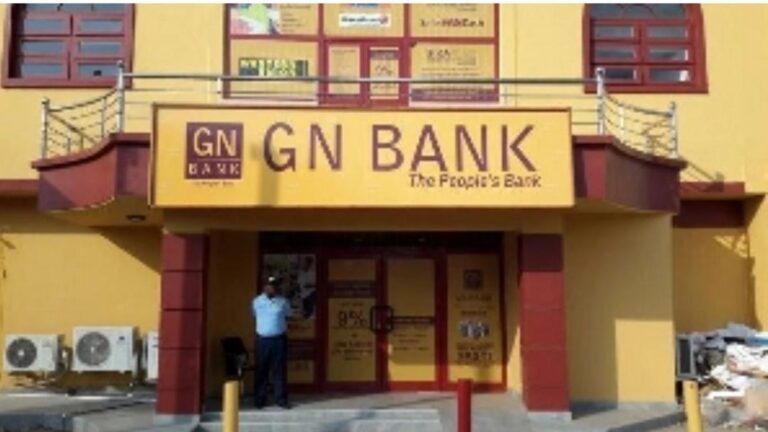
BoG dismisses claims of GN Bank license restorations The Bank of Ghana (BoG) has ruled out restoring banking license of GN Bank, which was downgraded to GN Savings and Loans  Company  Limited before its License was revoked. According to the Governor, of the Bank Of Ghana, Dr. Johnson Asiama, the Supreme Court has settled the case, leaving no room for further regulatory  or legal reconsideration. This clarification follows social media reports claiming that the Bank of Ghana had restored GN Bank license. Speaking in an interview with Graphic Online, as sighted by Ghanaweb Business, Dr. Asiama defended the central Bank’s decision to revoke GN Bank’s license in 2019. He explained the move was justified due to multiple regulatory breeches . ‘there is a supreme court ruling on the matter.The review also failed. So, nothing can be done. We are, however, open to considering applications for a new license  from anyone who is not connected to the directors of the defunct GN Savings and Loans comapny Ltd” he said. GN Bank’s License was revoked in 2019 as part of the central bank’s efforts to protect depositors’ fund and stabilise the country’s financial sector. The revocation came after the bank failed to comply with financial regulations, which undermined its operational capabilities. The Bank felt short in areas such as capital adequacy ,liquidity and risk management control. The collapse of GN Bank/GN Savings and Loans Company Ltd formed part of the broader banking sector clean – up exercise , which led to the revocation of Licenses of several commercial banks, savings and loans companies, and microfinance  institution. https://www.ghanaweb.com/GhanaHomePage/business/BoG-dismisses-claims-of-GN-Bank-license-restoration-2020529 Source:GhanaWeb

PUBLIC NOTICE!

AUCTION SALE OF CHATTELS! Members of the public are hereby notified that an auction sale of chattels will be held at First Allied, Suhum Branch: DetailsDate: Monday 2nd February 2026Time: 8:30 amVenue: First Allied, Suhum Items to be auctionedOffice tables, office chairs, computer equipment, air conditioners and other assorted office furnishings Conditions and Payment modalities The highest bidder shall be the purchaser. All chattels are sold on “as is” basis. Payment is done on the same day otherwise the bidder forfeits the offer. All interested parties are invited to attend and participate in the auction. Organised by: Wildos Auctions and Broadway Mart For further details, please contact  0242439441 or 0244381303

PUBLIC AUCTIONS – MOTORBIKES

PUBLIC AUCTION – MOTORBIKES FOR SALEMembers of the public are hereby notified that an Auction Sale of a range of motorbikes will be held on 25th November 2025.KINDLY NOTE THAT ALL MOTORBIKES ARE SOLD STRICTLY ON AN “AS IS” BASISAuction Details: Various makes and models available. Ideal for riders, mechanics, resellers, etc. Date & Time: 25th November 2025 10:00 am Venue: Unicredit Ghana Limited – Ashiaman Branch -Tema  Viewing & Auction:Viewing starts at 8:30 am before the auction begins.For inquiries, contact: 0242439441 Organised by:Wildos Auctions——–📞 0244381303Broadway Mart ———📞 0246004242

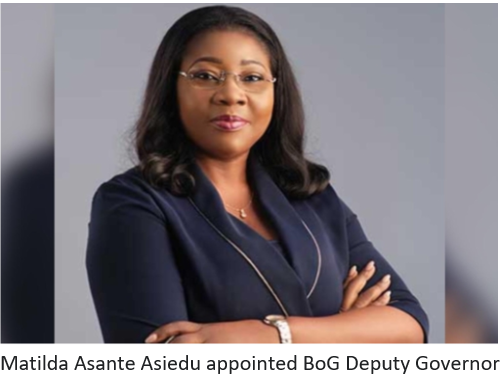
Matilda Asante-Asiedu appointed BoG Deputy Governor

The Group Head of Retail Banking at Access Bank (Ghana) PLC, Matilda Asante-Asiedu, has been appointed as the second deputy Governor at the Bank of Ghana (BoG) Her appointment is in accordance with Section 17 of the Bank of Ghana Act, 2002 (Act 612) as amended.   The Minister of State in charge of Government Communications and presidential spokesperson, Felix Kwakye Ofosu made this known in a statement issued Monday afternoon [April 28, 2025],   Mrs. Asante-Asiedu is a Chartered Banker and corporate leader who has served as Group Head, Retail Banking at Access Bank Ghana PLC.   She holds an MBA in Marketing from GIMPA Business School (2021), an MA in Journalism Studies from Cardiff University (2005), and diplomas in Journalism (Ghana Institute of Journalism, 1997) and Politics and Public Affairs Reporting (International Institute of Journalism, Berlin, 2000).   She is a Chartered Executive Banker (CIB-Ghana, 2024).   She has undertaken Executive Programmes at Said Business School at Oxford University (2023), Wharton School (2015) and Marquette University’s Les Aspin Centre (2003), among others.   Prior to moving into the banking sector at Access Bank, Matilda Asante-Asiedu worked as a journalist at Joy FM from 1997 to 2009.   She also worked as a consultant/specialist to international organisations. Between May 2010 and June 2015, Matilda Asante-Asiedu worked as Head of Corporate Communications and Brand Management at Access Bank.   With her expertise in Corporate Reputation Management and Stakeholder Engagement she managed the Bank’s reputation and spearheaded community investments.   Before her appointment as Group Head for Retail Banking in July 2017 at Access Bank, Matilda Asante-Asiedu was the Head of Exclusive Banking, where she led the execution and promotion of the Bank’s strategy for women.   She also managed the Bank’s Embassies and NGO’s portfolios as well as Private Banking, all of which form part of her current Portfolio. Attached below is a copy of the statement issued by Felix Kwakye Ofosu, Minister of State in charge of Government Communications President Mahama appoints Second Deputy Governor of the Bank of Ghana President John Dramani Mahama has in accordance with Section 17 of the Bank of Ghana Act, 2002 (Act 612) as amended, appointed Mrs. Matilda Asante-Asiedu as the Second Deputy Governor of the Bank of Ghana. Mrs. Asante-Asiedu is a Chartered Banker and seasoned corporate leader who has served as Group Head, Retail Banking at Access Bank Ghana PLC. Mrs Asante-Asiedu holds an MBA in Marketing from GIMPA Business School (2021), an MA in Journalism Studies from Cardiff University (2005), and diplomas in Journalism (Ghana Institute of Journalism, 1997) and Politics and Public Affairs Reporting (International Institute of Journalism, Berlin, 2000). A Chartered Executive Banker (CIB-Ghana, 2024). She has undertaken Executive Programmes at Said Business School at Oxford University (2023), Wharton School (2015) and Marquette University’s Les Aspin Centre (2003), among others.

President Mahama swears in BoG Governor, First Deputy

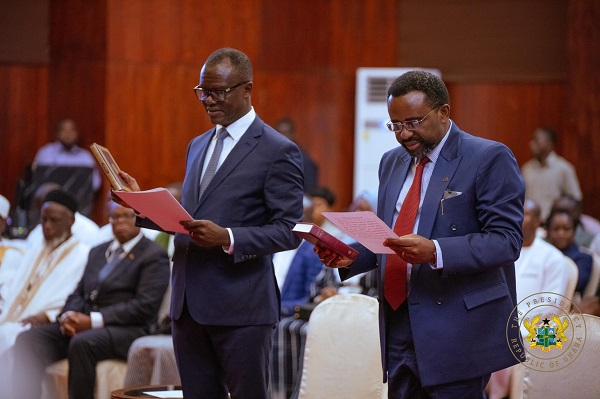
President John Dramani Mahama has officially sworn-in Dr. Johnson Pandit Asiama as the new Governor of the Bank of Ghana (BoG) in a ceremony held at the Jubilee House. Dr. Asiama’s appointment comes at a critical time for Ghana’s economy, with ongoing efforts to stabilize inflation, manage foreign exchange volatility, and implement monetary policies aimed at ensuring sustainable economic growth. As Governor, Dr. Asiama will be responsible for steering Ghana’s central bank towards achieving price stability, strengthening financial sector resilience, and fostering economic development in line with the government’s broader fiscal policies. In addition, Dr. Zakari Mumuni has been sworn in as the First Deputy Governor of the Bank of Ghana. He will support Dr. Asiama in formulating and executing monetary policies, overseeing financial regulations, and ensuring the soundness of the banking sector. With extensive backgrounds in macroeconomics, banking regulation, and financial management, both Dr. Asiama and Dr. Mumuni are expected to play pivotal roles in enhancing investor confidence, stabilizing the local currency, and promoting a robust banking environment. https://www.youtube.com/watch?v=EYFOX5AFRZk

President Mahama nominates Dr. Johnson Asiamah as BoG Governor

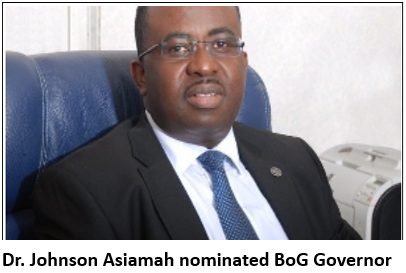
President John Dramani Mahama has nominated Dr. Johnson Asiamah as the new Governor of the Bank of Ghana, pending approval by the Council of State. The nomination follows a formal request by the current Governor, Dr. Ernest Addison, to proceed on terminal leave ahead of his retirement on March 28, 2025. Dr. Johnson Asiamah nominated BoG Governor Dr. Ernest Addison, who has served as Governor since April 2017, successfully completed two full terms after being reappointed in March 2021. In his place, President John Dramani Mahama has tapped Dr. Johnson Asiamah, a seasoned economist and former Second Deputy Governor of the Bank of Ghana, to lead the apex bank. Dr. Asiamah held the role of Second Deputy Governor between 2016 and 2017 and brings over 23 years of experience at the Central Bank. A holder of a PhD in Economics from the University of Southampton in the UK, Dr. Asiamah is known for his extensive expertise in monetary policy formulation, financial stability regulation, and economic research. “He has a wealth of experience in banking having worked at the Bank of Ghana for over 23 years. “He has over the years demonstrated commitment to implementing sound monetary and exchange rate policy, fostering a stable financial system, as well as promoting accelerated economic growth in Ghana,” the letter issued and signed by the acting Spokesperson to the President, Felix Kwakye Ofosu read.

BREAKING: BoG Governor Dr. Ernest Addison proceeds on terminal leave ahead of retirement

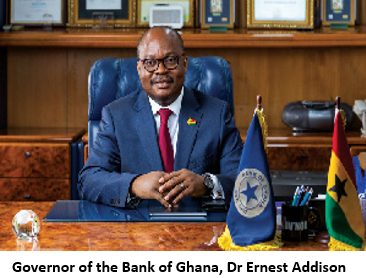
The Governor of the Bank of Ghana, Dr. Ernest Addison, is set to proceed on terminal leave starting February 3, 2025, ahead of his official retirement from the central bank. Dr. Addison, who has served as Governor since April 3, 2017, was reappointed for a second term on March 29, 2021. In accordance with the Bank of Ghana Act, 2002 (Act 612), as amended, his tenure is scheduled to conclude on March 28, 2025, marking the successful completion of two full terms in office. According to a statement from the Bank, Dr. Ernest Addison has decided to utilize his accumulated leave prior to his retirement. The decision, effective February 3, 2025, has been approved by President John Dramani Mahama. The Bank of Ghana expressed gratitude to Dr. Addison for his exceptional service to the institution and the nation. The Central Bank also acknowledged his “meritorious and distinguished service” and extended best wishes for a restful retirement.

Decisive action saved Ghana’s banking sector from collapse in 2017, says BoG Governor

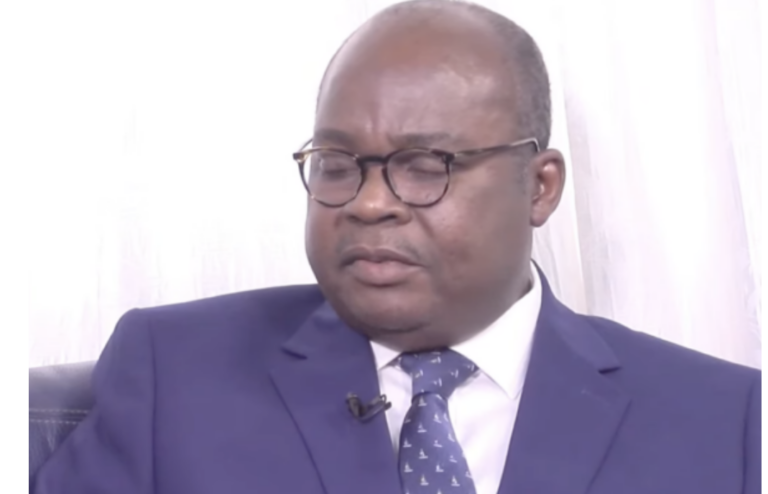
The Governor of the Bank of Ghana (BoG), Dr Ernest Yedu Addison, provided a detailed account of the banking sector crisis that plagued Ghana in 2017.  He recounted the drastic measures taken to salvage the sector and establish a more robust financial ecosystem. A sector on the Brink “When I took office in 2017, the banking sector was in a near state of collapse,” Dr. Addison revealed. “People were queuing to withdraw their money. The International Monetary Fund (IMF) flagged this as the most pressing crisis facing the country at the time.”  The severity of the situation demanded swift and decisive action, he explained, with the immediate priority being to stabilize the sector and restore public confidence. License revocations and clean-up One of the first steps involved the revocation of licenses for two banks, Capital Bank and UT Bank, in August 2017. “This was part of the prior actions to address the sector’s insolvency,” Dr Addison noted. Over the following years, additional weak and insolvent institutions were removed from the system. “By 2019, the sector had been cleaned up,” he said.   “We had removed all the weak institutions and those that remained met the new capital requirement of ¢400 million. These banks had stronger capital, adhered to new corporate governance directives, and were being properly supervised.” Dr. Addison highlighted some of the issues that necessitated these license revocations, including insider trading, related-party transactions, and non-compliance with prudential rules. “These practices undermined the stability of the banking system, but through stricter scrutiny and governance reforms, we have addressed them,” he affirmed. A Stronger Sector, Yet New Challenges Despite the strides made, Dr. Addison acknowledged that the post-cleanup era presented new challenges. “The banks were in a much better place by 2019, with stronger capital to support growth. Interest rates had come down from 28% to around 21%, creating an environment conducive to lending to the private sector,” he explained. However, the onset of the COVID-19 pandemic disrupted this trajectory. “Suddenly, the government became the main borrower in the economy.  The banks, instead of lending to the private sector, channelled their recapitalized resources into acquiring government bonds,” Dr Addison said. Debt Exchange and Its Impact on Banks The government’s rising debt levels and eventual inability to secure further borrowing from capital markets triggered a debt crisis, further complicating matters for banks. “The debt exchange program resulted in significant losses for the banks,” Dr. Addison admitted. Despite these setbacks, he maintained that the reforms initiated during the crisis have left the banking sector in a stronger position to navigate economic challenges. “The decisions we made were difficult, but they were necessary to restore stability and create a banking sector that can withstand shocks,” he stated.  Looking Ahead Dr. Addison stated that the lessons learned from the crisis have informed ongoing reforms to strengthen the financial sector. “Our focus remains on ensuring that banks are well-capitalised, properly managed, and capable of supporting sustainable economic growth,” he concluded.